
DAAD Scholarships 2027: How to Apply, and Every Visa and Document You Will Need
Published Nov 6, 2026 · Updated Nov 18, 2026
Winning a DAAD scholarship is only half the journey. The other half is paperwork: the right documents for the scholarship, then the right documents for your German student visa. Many strong candidates lose months, or even their seat, because a transcript wasn't attested or their proof of funds was in the wrong form.
The DAAD (German Academic Exchange Service) is funded by the German government. It supports international students and researchers at master's, doctoral and postdoctoral level. There is no single "DAAD scholarship". It is a family of programmes, and each one has its own call, eligibility rules and deadline. So the first step is always to find the programme that fits you in the DAAD scholarship database and read its official call line by line.
This guide walks you through both stages, with a special focus on documents and the visa process.
What the Scholarship Covers and Who Can Apply
A full DAAD master's scholarship pays €992 a month. Doctoral candidates usually receive €1,300 a month, and EPOS doctoral rates rose to €1,400 from February 2026. On top of that, most awards include:
- health, accident and personal liability insurance
- a travel allowance
- an annual study allowance of €460
Some programmes also add a rent subsidy, family allowances and a German language course before studies begin.
The programmes most relevant to students from developing countries, including Pakistan, are:
| Programme | Who it suits | Typical application window |
|---|---|---|
| EPOS (Development-Related Postgraduate Courses) | Professionals in development-linked fields, usually with 2+ years of work experience | Set by each university, often August to October for the following year |
| Helmut-Schmidt-Programme (Public Policy and Good Governance) | Future leaders in policy, law, economics and administration | Around 1 June to 31 July |
| Study Scholarships for Master's (all disciplines) | Recent graduates in any field | Country-specific, check the database |
| Research Grants (doctoral) | PhD candidates and young researchers | Country-specific, often autumn |
A few eligibility rules appear in almost every call:
- Your last degree usually must not be more than six years old at the deadline.
- You can't apply if you are already studying for a master's or doctorate in Germany.
- You must meet the language requirement of your chosen course, whether that is English or German.
Stage One: Documents for the Scholarship Application
Each call publishes its own checklist, and DAAD only considers complete applications. Most programmes ask for some version of the following:
- DAAD application form. Fill it in on the DAAD portal, then sign and date it where required.
- Signed DAAD checklist. This is needed for Helmut-Schmidt and some EPOS courses. Print it, tick each item, sign by hand and scan it.
- CV. Usually a table or the Europass format, signed and dated. Keep it to about three pages.
- Motivation letter, signed. Explain why this course, why Germany, and how you will use the degree back home.
- Degree certificates and transcripts for every degree, with an explanation of the grading system.
- Language certificate. IELTS or TOEFL for English-taught courses, or TestDaF or Goethe for German-taught ones.
- Proof of work experience. Employer letters with dates and duties. This is essential for EPOS and Helmut-Schmidt.
- Reference letters from professors or employers, signed and on letterhead.
- Research proposal and supervisor confirmation for doctoral and research grants.
- Certified translations of any document that isn't in English or German.
Pay attention to where you send it. For EPOS and Helmut-Schmidt, you often apply directly to the university, which then nominates candidates to DAAD. For other programmes, you upload everything to the DAAD portal. Sending it to the wrong office can get you excluded, so follow your course page exactly.
Keep a clean PDF of every document. If you are selected, you'll be asked to upload them to the DAAD portal. Many of the same papers will also go into your visa file.
Stage Two: The German Student Visa (National Visa, Type D)
Any stay in Germany longer than 90 days needs a national visa, called a D visa. As a DAAD scholar, you will apply for a student visa. Some doctoral and postdoc grants use a researcher visa instead. Once you arrive, the local foreigners' office turns it into a residence permit.
The official checklist comes from the German embassy or consulate that covers where you live. Always download the latest version from its website. In general, expect to provide:
- Valid passport with at least 12 months left and two blank pages, plus copies of the data page
- National visa application form, filled in online and signed
- Recent biometric passport photos that meet German requirements
- University admission letter (Zulassungsbescheid), or a conditional admission or language course confirmation
- DAAD Letter of Award stating the monthly amount and how long the funding lasts
- Proof of health insurance valid from the day you enter Germany
- Academic certificates and transcripts, attested as your country requires
- Language certificate that matches the teaching language of your course
- Motivation letter and CV describing your study plan
- Visa fee of €75, usually paid in local currency at the embassy's exchange rate
Documents must be readable, complete and consistent with what you typed into the online form. A different spelling of your name or a missing page is enough to delay a decision by weeks.
Financial Proof: Blocked Account or DAAD Award Letter?
This is where DAAD scholars have a real advantage. Germany requires every student visa applicant to prove they can cover their living costs. In 2026, the standard proof is a blocked account (Sperrkonto) holding €11,904 for one year. The money is released to you at €992 a month.
A DAAD award letter is accepted as proof of funding instead of a blocked account. In some cases DAAD sends the Letter of Award to the German embassy directly. Still, keep the original letter in your visa file and present it exactly as issued, not as a summary.
A few things to check before you skip the blocked account:
- Does your award cover the full amount? A full DAAD master's stipend of €992 a month matches the visa requirement exactly. A partial award, or one that pays only tuition or travel, may not be enough on its own.
- Does it cover the whole stay? If your funding starts after a preparatory language course, you may need to show funds for the gap.
- What does your embassy say? The accepted proof can vary by country, so confirm with the embassy or consulate handling your application.
If you need to make up a shortfall, the other accepted options are:
- a blocked account
- a formal obligation letter (Verpflichtungserklärung) from a sponsor living in Germany
- a bank guarantee
Health Insurance
You need valid health insurance from the day you land. Most DAAD scholars are enrolled in the DAAD group insurance, which covers health, accident and personal liability. Your award letter should confirm this, and you can use it as insurance proof for the visa.
A regular travel policy isn't enough to enrol at a German university. Check what cover your award gives you before you buy anything separately.
If You Are Applying from Pakistan
Pakistani applicants have a few extra steps. They take time, so start them as soon as you apply for the scholarship.
1. Get your documents attested in the right order. University degrees and transcripts go to the Higher Education Commission (HEC) first. Matric and Intermediate certificates go to IBCC or your board. Only after that can the Ministry of Foreign Affairs (MOFA) attest them. A missing HEC or MOFA stamp is one of the most common reasons files get held up.
2. Keep NADRA documents ready. Visa applicants are routinely asked for their Family Registration Certificate (FRC) and birth certificate.
3. Check the APS requirement. APS is a check of your academic documents run through the German Embassy in Islamabad. The rules, and any exemptions for scholarship holders, can change. Before you book anything, confirm on the German Missions in Pakistan website whether you need an APS certificate.
4. Apply through the Consular Services Portal. Student visa applications are now submitted online through the German Foreign Office's Consular Services Portal (digital.diplo.de, under "Studium"). You upload clear scans and the embassy reviews them. Then you're invited to an appointment to give your fingerprints and photo.
5. Know which office handles your application.
- The Embassy in Islamabad covers Islamabad/Rawalpindi, Punjab, Khyber Pakhtunkhwa, Gilgit-Baltistan and AJK.
- The Consulate General in Karachi covers Sindh and Balochistan.
Confirm your region on the embassy website, since arrangements can change.
There's good news too. In November 2026, Germany's ambassador to Pakistan announced that Germany is issuing more student visas to Pakistanis. Demand is still high, though, so a complete first upload saves you weeks.
A Realistic Timeline
- 12 to 15 months before your start date: pick your programme in the DAAD database and start getting your degrees attested.
- Application window (June to October, depending on the programme): submit your scholarship application with every document on the checklist.
- Selection (usually February to March): results arrive. If you're selected, upload your documents to the DAAD portal and accept the award.
- Right after the award: start your Consular Services Portal application and upload your Letter of Award, admission letter and attested papers.
- 4 to 12 weeks later: visa appointment, fingerprints and photo, then the decision. Processing times depend on demand.
- Before you fly: confirm your insurance, travel dates and any compulsory language course before your programme.
Mistakes That Cost People Their Visa
- Submitting transcripts without attestation, or skipping the MOFA step
- Using a travel insurance policy that doesn't meet student requirements
- Assuming a partial scholarship fully replaces the blocked account
- Names or dates that differ between your passport, degree and application form
- Waiting for the award before starting attestation, then running out of time
Final Word
A DAAD scholarship opens the door to tuition-free study and a fully supported life in Germany. The applicants who get there smoothly treat paperwork as part of the application, not an afterthought. Start early and follow the official checklists for both your programme and the German embassy. Keep every document consistent. Your future self, sitting in a lecture hall in Germany, will thank you.
Published by Jabeen
Editor, WorldOpportunitiesHub
Jabeen researches, writes and fact-checks every opportunity and guide on WorldOpportunitiesHub, verifying each one against its official source before it's published.
Ready to find your next opportunity?
Browse OpportunitiesOpportunities you might like
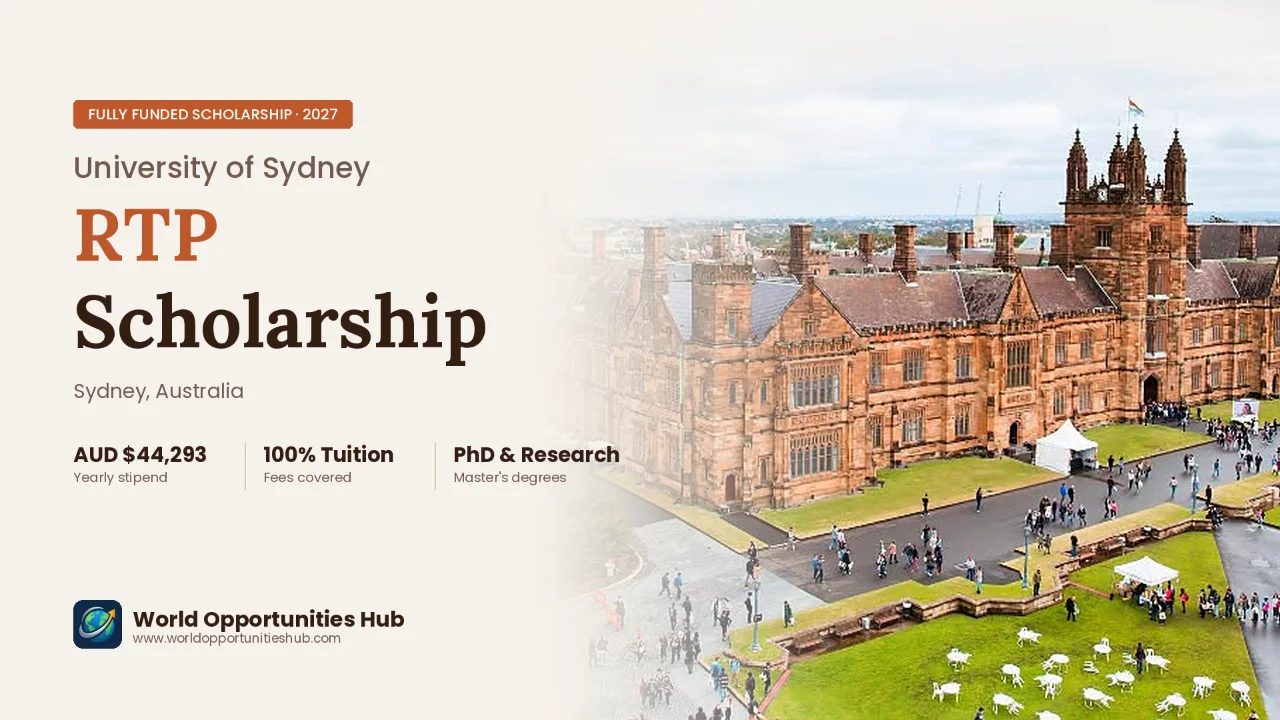
University of Sydney RTP Scholarship 2027 in Australia (Fully Funded PhD/Research)
The University of Sydney is offering fully funded Research Training Program (RTP) and equivalent university scholarships to international students starting or already enrolled in a PhD or research master's. It covers a yearly stipend of AUD $44,293 (2027 rate), full tuition fees for up to 14 research periods, and health cover. The next application deadline is December 18, 2026.

Riot Games Social Media Manager Internship 2027 in Los Angeles, USA (Paid)
Riot Games is hiring a Social Media Manager Intern for Summer 2027 in Los Angeles. You'd help run the day-to-day of Riot's global social channels — coordinating content, campaigns and community response across League of Legends, VALORANT and Riot's other games. It's a paid, 12-week internship open to students graduating in 2027 or 2028. Applications close January 4, 2027.

Riot Games Data Engineering Internship 2027 in Los Angeles, USA (Paid)
Riot Games is hiring a Data Engineering Intern for Summer 2027 at its Los Angeles studio. You'd work on real data pipelines and datasets alongside Riot's data engineers, data scientists and analysts, using Python or Java and SQL. It's a paid, 12-week internship aimed at students graduating in 2028. Applications close January 4, 2027.